8 October 2012
8,324 WORDS
PRESS KIT (UK)
NEW RENAULT CLIO:
HIGH ON EMOTION
Taking all its different generations into account, Clio stands out as one of Renault’s best-selling cars, as well as a market benchmark that has generated total sales of almost 12 million since 1990. Today, Renault has capitalised on the model’s hallmark strengths and everyday versatility to deliver New Clio which seeks to win over customers thanks to its attractive blend of emotion and key selling points.
New Renault Clio also champions Renault’s new design identity which places the emphasis on simplicity, warmth and sensuality.
Thanks to the availability of two systems, including the introduction of Renault R-Link, New Renault Clio breaks new ground in the world of automotive multimedia too. It also delivers a high standard of comfort and safety equipment across the range and features an affordable personalisation programme on an unprecedented scale for Renault.
New Clio’s versatility is built upon even more efficient roadholding and enhanced travelling comfort, while power is provided by a choice of engines that show the way forward in terms of low fuel consumption and CO2 emissions. The range includes the French marque’s latest downsized engine, a new three-cylinder 0.9-litre petrol, plus a diesel powerplant which returns an unbeatable 88.3 mpg and 83g of CO2/km.
Meanwhile, New Clio boasts a spacious and comfortable interior, with large and practical boot (300dm3). It is also rigorously designed, targets the highest possible level of active and passive safety (5 stars Euro NCAP new rating) and is built to Renault’s exacting quality standards.
Buoyed by the passion of the teams behind its design, New Clio, like its predecessor, continues to pack features that are normally only associated with larger cars and responds to market demands in a rational, yet emotional way.
The hatchback version of New Clio will go on sale in October 2012, while Clio Estate (not destined for the UK) and Clio Renaultsport are scheduled to follow in the second quarter of 2013.
01 - NEW CLIO: AN INCARNATION OF RENAULT’S NEW DESIGN IDENTITY
02 - A PERSONALISATION PROGRAMME COVERING CORE-RANGE VERSIONS
03 - PACKED WITH INNOVATIONS
04 - SHOWING THE WAY FORWARD IN TERMS OF LOW FUEL CONSUMPTION, LOW CO2 EMISSIONS… AND DRIVING ENJOYMENT
05 - ROBUST, AGILE AND COMFORTABLE
06 - A LEVEL OF QUALITY ASSOCIATED WITH LARGER SALOONS
07 - A PASSIONATE RESPONSE TO WHAT THE MARKET WANTS
01 - NEW CLIO: AN INCARNATION OF RENAULT’S NEW DESIGN IDENTITY
New Renault Clio is the first production model to give full expression to the Renault design renaissance inspired by Laurens van den Acker. The objective was to take the style and emotion of the brand’s concept cars and carry them over to production models. New Clio meets that goal.
“New Renault Clio was conceived as a piece of sensuous sculpture which stimulates desire. Like muscles, its curves express the dynamism radiated by the DeZir concept car. No acute or aggressive angles, just voluptuous curves that make you want to reach out and caress it.”
Laurens van den Acker - Senior Vice President Corporate Design Renault
SIMPLE, SENSUOUS AND WARM… NEW CLIO IS A CAR TO FALL IN LOVE WITH
“Simple, sensuous and warm: these are the three words that sum up the design of Clio – just like that of DeZir. This is no coincidence, since the two vehicles were designed by the same team. New Clio is a practical five-door family car with the sporty coupé profile of a three-door, and is all about passion. Thanks to the skills of our engineering teams, the end result matches our original vision.”
Antony Villain - Design Director, Studio 1
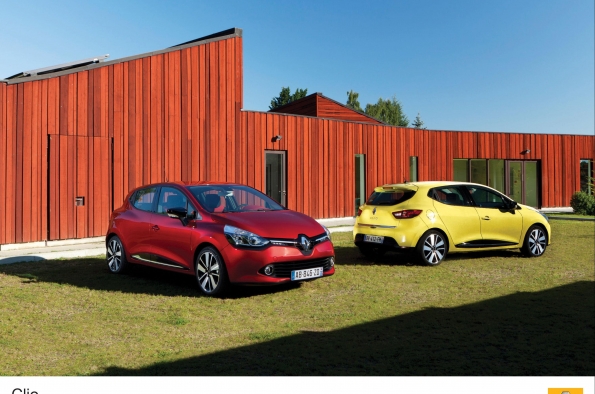
New Clio is instantly recognisable thanks to its front-end styling which features a prominent Renault logo, set bold and upright against a gloss black background, a signature first seen on the DeZir concept car. This front end styling is made more distinctive still by the headlights units, which include chrome details and LED daytime running lights.
Available exclusively in a five-door bodystyle, New Renault Clio has a sporty silhouette, accentuated by the integrated rear door handles concealed close to the rear quarter lights.
New Renault Clio will be available from launch in a choice of seven body colours, four of which are new. One of these is the distinctive launch colour, Flame, which takes its inspiration from the DeZir concept car.
Non-metallic finishes:
Glacier White French Blue* Inca Yellow*
Metallic finishes:
Flame ** Mercury Oyster Grey
Diamond Black
* New colours
** A new ‘special effect’ finish inspired directly from that of the DeZir concept car
BALANCED, DYNAMIC EXTERIOR PROPORTIONS WHICH EXPRESS SPORTINESS AND CONFIDENCE
Renault designers paid particularly careful attention to achieving balanced proportions for New Clio. Standing at 4,062mm in length, 1,732mm wide (excluding door mirrors) and 1,448mm tall, it sits 45mm closer to the ground than its predecessor. Meanwhile, the front and rear track have been significantly widened (by between 34 and 36mm).
The lower ride-height ensures an assertive stance which is also beneficial to the car’s aerodynamics. Pronounced shoulder lines make New Clio visually distinctive.
New Clio’s coupé-like silhouette is accentuated by the integrated rear door handles concealed close to the rear quarter lights.
The ratio of wheel-size to vehicle-height has been fine-tuned for a more dynamic look. The large-diameter wheels are pushed 15mm outwards compared with Clio III in order to fill and finish flush with the wheelarches. A steeply raked windscreen adds to this dynamic feel, as does the improved glass to body ratio when New Clio is seen from the side (one-third and two-thirds respectively).
A MODERN, WELCOMING, OCCUPANT-FRIENDLY INTERIOR
“We wanted to capture the essence of an aircraft wing; a shape that is both light and strong. This was the reasoning behind the design of the dashboard. It produces an impression of energy, a dynamic flow which envelopes the driver with a blend of taut and fluid lines, combined with forms that are expressive and energising.”
Matteo Piguzzi – Interior Designer
The desire to combine beauty with functionality shows through clearly in numerous aspects of the interior design, from the dashboard in the shape of an aircraft wing, to the neat packaging of the multimedia systems in the centre console, the availability of stowage space throughout the cabin and careful attention to detail. The wide choice of colours and the use of chrome and gloss-black highlighting add to the warmth exuded by the cabin.
New Clio’s range of easily distinguishable equipment levels and interior trims provides customers with a choice of inspiring and exciting ambiences.
A CHOICE OF FINISHES, EACH WITH ITS OWN
PERSONALITY
Each of the New Clio range’s equipment levels and trims has its own personality and ambience. The quality of the design and materials (e.g. colour inserts in the upholstery) is apparent even in the case of the extensively-equipped entry-level version (height- and reach-adjustable steering wheel, 60/40-split folding rear seats, electric front windows and mirrors, plus keyless entry and ignition – all of which are standard across the range).
A lavishly-appointed, range-topping ‘Initiale Paris’ version will be added in 2013 (not in UK).
The exact specification and name of the different equipment levels will differ in some of New Clio’s markets.
02 - A PERSONALISATION PROGRAMME COVERING CORE-RANGE VERSIONS
Both inside and out, New Clio was designed from the very beginning to take personalisation to a new level, from the steering wheel to the side protection mouldings. There are countless combinations and buyers will be able to select a specific character for their New Clio based around one of two decor themes (UK market): ‘Le Mans’ and ‘Tricolore’. There is something for every budget, while personalisation features are fitted at the factory and available for the best-selling versions.
ORIGINAL AND “UNMISTAKABLY RENAULT”
The personalisation programme is structured around two (UK) distinct themes (‘Le Mans’ and ‘Tricolore’), plus a selection of configurations based on a careful match between body colour and the dominant colour of the graphics and wheels.
The personalisation programme features:
• Five exterior decor packs to enhance different areas of the body with chrome or colour trims.
• Two different roof decal designs.
• A choice of two colours for the 16-inch ‘Passion’ alloy wheels and a choice of the 17-inch ‘Desire’ alloy wheels.
• Seven interior decor packs which highlight different parts of the cabin with colours or motifs.
• Three interior ambience packs which co-ordinate the colour of the dashboard colour with that of the upholstery and door panels.
For the exterior:
• Exterior colour elements are available in five different finishes: Chrome, Black, Red, Blue and Ivory. These finishes concern the grille, rear hatch and side protective moulding trims. In addition, the door mirror housings, rear bumper apron and side protective mouldings are picked out in gloss black lacquer.
• The roof decal designs come in a choice of two different themes (UK): ‘Le Mans’ or ‘Tricolore’.
• The 16-inch diamond-effect ‘Passion’ wheels in chrome are also available in a choice of two colours: Black or Ivory.
• The 17-inch ‘Desire’ alloy wheels will be available with a choice of four colour inserts: Black, Red, Blue or Ivory.
For the interior:
Interior gloss touches are available in a choice of four colours (Black, Red, Blue, or Ivory) and echo the same two themes as the roof decal designs (‘Le Mans’ and ‘Tricolore’). These highlights concern the steering wheel, door panels, gear lever surround and air vent surrounds and are directly incorporated using a technique known as insert moulding.
In the case of the Dynamique trim level, customers can choose from three colours for the interior trim (Black, Red or Blue). These colours apply to the dashboard trim strip and door panels, with a matching colour for the upholstery. A finishing touch for each ambience comes in the form of colour co-ordinated carpet mats, available as accessories.
PURPOSELY DESIGNED
The personalisation programme emphasises New Clio’s assertive character. From the very start of the project, areas lending themselves to highlighting were incorporated into the model’s design.
AFFORDABLE AND VERSATILE
A New Clio’s personalisation programme means that made-to-measure looks are now available for a versatile five-door family car. The programme covers all the different engine variants and the best-selling versions, making it an affordable reality for the bulk of the model’s customers.
CREATE AND SHARE YOUR FAVOURITE CLIO
Examples of Clios personalised with off-the-shelf configurations will be on display at dealerships from launch date to show customers the scope of possibilities opened up by the three different personalisation themes.
A dedicated website provides a taste of the range of personalisation possibilities available for New Clio. Web users can go to http://clio.renault.com/ to configure and view their ideal New Clio.
03 - PACKED WITH INNOVATIONS
New Renault Clio is poised to shake up the market by bringing a number of technological innovations to a much wider audience. True to tradition, it also establishes a new benchmark for its class in terms of its performance and equipment packages. On the multimedia front, New Clio packs an unprecedented double punch for this level of range, while audio quality has been boosted by the introduction of the Renault Bass Reflex system, not to mention the availability of a reversing camera among the long list of equipment…
ADVANCED BLUETOOTH® RADIO FROM THE ENTRY LEVEL VERSION
New Renault Clio features a range of Bluetooth® radios with audio streaming. Occupants can enjoy music stored on portable players and also benefit from hands-free use of their telephone. The radio has access to numbers stored on the driver’s mobile phone (depending on telephone), while the car is equipped with its own microphone. Sound processing quality has been optimised and all radios come with a jack socket and a USB port to charge and scroll through the menus of portable music players and mobile phones.
MEDIA NAV: ESSENTIAL MULTIMEDIA FUNCTIONS
New Renault Clio proposes a choice of all-new multimedia solutions. Built into the centre console, the MEDIA NAV system provides all the basic multimedia functions and is standard equipment for two of the model’s three equipment levels. Thanks to its seven-inch (18cm) touchscreen display, it is intuitive to use and, in addition to the radio, includes Bluetooth® connectivity for audio streaming and hands-free telephony. Portable music players can be connected via the fascia-mounted USB port or jack socket. MEDIA NAV also incorporates Nav N Go navigation with 2D and 3D (Birdview) display. The USB port and a dedicated web interface make it easy to update NAVTEQ maps.
RENAULT R-LINK: AN INTEGRATED TABLET CONNECTED TO THE CAR AND THE INTERNET (AVAILABLE AT A LATER DATE)
Having been first on the market with notable innovations such as steering wheel-mounted remote control of the radio (1982, R11 Electronic) and in-car navigation (1994, Safrane); after bringing keyless entry to volume cars (in 2001) and GPS navigation with high-resolution graphics (Carminat TomTom®, priced at £460 (UK) in 2010); and having launched on-board connected navigation in the shape of Carminat TomTom® LIVE for Clio, Renault continues its stream of innovations with Renault R-Link.
Available as an option for New Clio from Dynamique upwards, Renault R-Link will certainly appeal to technically-minded motorists and provides a bridge between the car and the connected world outside thanks to:
• A large seven-inch (18 cm) touchscreen display, intuitive voice commands and, a market first, a home page that can be personalised by the user for safe, simple access to key functions, without the driver having to take his or her eyes off the road.
• A menu with six icons which provide access to the six main functions: Navigation, Multimedia, Phone, Vehicle, Services and Applications, and System.
• TomTom® connected navigation including LIVE services: the market’s best real-time traffic information service, minimisation of journey times and fuel consumption.
• A connection with the car’s own electronic systems permits access to an advanced eco-driving function (Driving eco²) which analyses the driver’s behaviour and provides advice to help reduce fuel consumption.
• Renault R-Link Store, the automobile world’s first-ever evolving Application Store. Users can easily view or download a comprehensive selection of apps from their car or computer (via ‘MyRenault’).
Key functions and information available on the centre console
Renault R-Link’s user-friendly seven-inch (18cm) touchscreen display forms an integral part of the modern centre console and provides a full range of multimedia functions (navigation, radio, Bluetooth® telephony and audio-streaming, connectivity for portable music players, connected services, ‘eco’ driving, etc.) in one place for maximum comfort and enjoyment.
Renault R-Link ensures that information is available as and when it is needed, thereby avoiding the driver having to take his or her eyes off the road. Renault R-Link’s touchscreen display permits fingertip control which doubles up with the steering wheel-mounted remote controls for the audio and telephone functions. It can also be controlled using intuitive voice commands to dictate the address of a destination for navigation purposes, for example, or to call up different functions using instructions such as ‘telephone’, ‘apps’, ‘send an e-mail’, etc. This facility makes use of the system even more practical and safer. The Text To Speech function (TTS) permits messages or RSS feeds to be read out loud.
R-Link apps cover a wide range of useful functions:
• Communication: e-mails, social networking, web navigation, etc.
• Journey optimisation: TomTom® LIVE services (HD Traffic®, speed control warnings [where authorised], TomTom Places, weather forecasts, Coyote Series alerts [depending on country], fuel prices, location of parking places, etc.).
• Practical information: personal phone numbers, Yellow Pages, hotels, restaurants, etc.
• Mobility: multi-mode journey planning, public transport.
• Budget guides: ‘by-the-kilometre’ insurance, Renault tips, etc.
• Vehicle information: monitoring of vehicle servicing, owner manual, etc.
• Entertainment and leisure: games, information, travel information, engine sound profile, personalisation, etc.
• Professional use: fleet Managers will benefit from services for their business needs thanks to the vehicle connections
The apps developed for Renault R-Link are designed to make life easier for the driver, however, access to certain functions is understandably restricted while on the move. For example, functions which are overly interactive or long to use may only be used when the vehicle is at a standstill.
The catalogue of apps will cover a wide spectrum of uses, extending from journey optimisation (TomTom LIVE services, fuel prices, location of parking places) and vehicle information (the monitoring of servicing, etc.), to budget guides (‘by-the-kilometre’ insurance, Renault tips, etc.), practical help (phone numbers, Yellow Pages, etc.), communications (e-mails, social networking, R-Tweet app) and entertainment/leisure (travel information, etc.) and emergency calls.
Renault’s intention is to make R-Link Store the benchmark automotive app store. To achieve this, it has favoured an open innovation strategy founded on input from major partners and development companies, as well as from start-ups which are brimming with exciting ideas in the field of connected services and apps for automotive use. Partners in France include Pages Jaunes, La Poste, I-Dispo, Elle, Balumpa, Michelin, Falk, Métro, Euronews, La Fourchette, Apila and NavX.
3D SOUND BY ARKAMYS®
The New Clio’s style is also expressed through sound. Depending on the model, this sound is delivered by two innovative systems with premium sound quality.
All versions equipped with Renault R-Link benefit from the 3D Sound by Arkamys® system, which provides exceptional sound depth and your choice of setting in the cabin with six speakers set around the inside. The space distribution created by the digital signal processing software provides an unparalleled sound clarity. The driver can also select where they want the sound: driver only, front seats, or the entire vehicle. The New Clio also introduces the Bass Reflex system, an innovation available as standard on all versions. Its clever system of "acoustic nozzles", integrated in the front door speakers, recreates the volume and audible pleasure of a 30 L subwoofer. With smooth bass, clear trebles, and layered sound, the auditory experience is that of a premium system.
BRINGING INNOVATION TO THE WIDEST POSSIBLE AUDIENCE
“New Renault Clio takes the attention paid to the details which influence travelling comfort to new heights. As is always the case at Renault, the difference stems from an ability to draw together a package of functions that are either unprecedented or only seen previously in higher superior segments, and then deliver them in a simple, straightforward way. The equipment and services available for New Clio could well change the face of everyday motoring.”
Ali Kassaï – (Programme VP, A/B range)
Safe
For enhanced safety and driving pleasure, nearly all the engines available for New Renault Clio incorporate hill start assist. When the driver lifts his or her foot from the brake pedal on a slope, the system – which is connected to the ESC – holds the vehicle stationary for two seconds, allowing the driver to pull away without the vehicle moving backwards.
Every version of New Clio is equipped with ESC, ASR traction control, ABS and emergency brake assist, as well as more direct variable-rate electric power steering which ensures a level of agility that is particularly appreciable in built-up areas.
The standard equipment list also includes cruise control with speed limiter, while New Clio comes with ‘motorway-mode’ indicators, an extremely practical feature which produces three flashes of the indicator when preparing to overtake by lightly moving the indicator stalk.
Practical
New Renault Clio is an entirely keyless car. The key is replaced by an electronic card (depending on equipment level) which locks and unlocks the doors and permits the engine to be started without the driver removing the card from his or her pocket, bag, wallet, etc.
All versions of New Clio come with a height – and reach – adjustable steering wheel. The long list of standard equipment is rounded off by electric, heated door mirrors, and electric front windows.
New Clio occupants benefit from plenty of practical stowage space located throughout the cabin:
• A tray in front of the gearlever which can hold items like a portable music or CD player, mobile phone.
• A large seven-litre glove box capable of containing a 1.5-litre bottle of water.
• A 1.2-litre tray situated above the glovebox.
• Two easy-to-access cup holders and additional stowage for small items between the seats at the foot of the centre console.
• Stowage in the optional central armrest (almost one litre).
• Bins in each door designed to contain a 1.5-litre bottle of water.
A single switch allows all the windows of New Renault Clio to be demisted at the same time, while the climate control system has been improved to run even more quietly and efficiently than that of Clio III.
A car which takes care of its occupants…
Certain versions of New Clio are equipped with automatic climate control complete with an active charcoal/carbon pollen filter and a toxicity sensor designed to prevent fine particles (pollen, dust, particulates) and pollutants (exhaust fumes, odours) from entering the cabin. When pollution is detected, the system – which is entirely controlled by the climate control system – responds by switching off the fan.
The introduction of the R-Link system has made it possible to bestow New Clio with a reversing camera which is located in the middle of the rear Renault logo. The image is shown on the multimedia screen and displays a dynamic graphic guide which varies as a function of the steering wheel position. This option is coupled with parking sensors that warn the driver when the car is getting close to an obstacle by altering the frequency of audible beeps. In the case of New Clios equipped with Renault R-Link, the display uses coloured zones (green, yellow, red) to indicate the position of obstacles. A reversing camera will be available at a later date for Media-Nav (fixed graphic guide).
…and the environment
Other technical innovations include the fitment of active flaps positioned in front of the radiator (certain versions only). New Clio is the first B-segment car to employ this technique which helps to reduce fuel consumption by adjusting the flow of air through the radiator (which generates drag) as a function of the cooling needs of the moment. In this way, the car’s drag is permanently optimised to minimise fuel consumption. In normal running conditions, or in fast-flowing traffic (e.g. on a motorway), closure of the flaps permits a fuel saving of approximately 2.8 mpg (0.1 litres/100km) at a stable speed of 80 mph.
A WORLD FIRST: THE RENAULT BASS REFLEX SYSTEM
All versions of New Renault Clio are equipped with a clever sound system integrated into the front doors’ loudspeakers. Known as Renault Bass Reflex, this system delivers the volume and listening enjoyment of a 30-litre home speaker enclosure. Occupants are sure to appreciate this technology which delivers more powerful bass frequencies, while at the same time pushing back saturation and distortion thresholds. The system is based on the use of vents – or ports – in the enclosure and its application is a world first for the automotive industry.
R-SOUND EFFECT: CHANGE THE ENGINE NOTE IN A CLICK
The R-Sound Effect app for Renault R-Link has seen Renault invent a means to personalise the engine sound. This new feature allows New Clio’s occupants to enjoy the engine sound selected by the driver. This custom sound varies as a function of the car’s speed and acceleration and is played through the vehicle’s loudspeakers. It is possible to choose between the sound of a Renault Sport race car, a V6 engine or four other realistic engine sounds simply by clicking on the Renault R-Link’s display. The algorithm which controls this function takes engine speed, vehicle speed and position of the accelerator pedal into account, to reproduce the sound with striking realism. Parameters such as volume are easy to adjust using the touchscreen display.
04 - SHOWING THE WAY FORWARD IN TERMS OF LOW FUEL CONSUMPTION, LOW CO2 EMISSIONS… AND DRIVING ENJOYMENT
Record low fuel consumption and driving enjoyment are just two of the New Renault Clio range’s strong points following the introduction of new petrol and diesel engines, EDC (Efficient Dual Clutch) transmission and ‘eco’ driving aids which showcase the savoir-faire of Renault’s engine specialists.
To combine low fuel consumption and driving enjoyment, the New Renault Clio line-up features an extensively renewed range of petrol and diesel engines. The new Energy TCe 90 and TCe 120 EDC petrol engines combine particularly low fuel consumption and CO2 emissions with punchy response. The latest-generation Energy dCi diesel engines have also been extensively revised and permit New Renault Clio to challenge for fuel efficiency records while still contributing to driving pleasure.
TWO NEW ENERGY ENGINES: ADVANCED TECHNOLOGY FOR EVERYDAY USE
New Energy TCe 90 petrol engine
This engine is the first three-cylinder engine to be produced by Renault and combines driving enjoyment with remarkable fuel efficiency.
• An 898cc turbocharged three-cylinder engine equipped with Stop&Start which delivers the performance of a 1.4-litre normally-aspirated engine.
• 90 horsepower at 5,250rpm.
• A very low inertia turbo for response at low engine speeds: 135Nm at 2,500rpm (90 per cent of this figure available from 1,650rpm).
• A lower emission version with taller gear ratios for fuel consumption of 65.7 mpg (combined cycle) and CO2 emissions of 99g/km, a saving of 21 per cent compared with the TCe 100 engine it supersedes.
New Energy dCi 90 diesel engine
The Energy family of engines has been extended with the introduction of a new 90-horsepower version of the 1.5 dCi which is equipped with Stop&Start:
• A four-cylinder 1.5-litre engine with peak torque of 220Nm available from as low as 1,750rpm (a gain of 20Nm compared with the current dCi 90).
• 90 horsepower at 4,000rpm.
• A lower emission version with taller gear ratios qualifies for the Renault eco² signature thanks to fuel consumption of 88.3 mpg (combined cycle), equivalent to CO2 emissions of 83g/km.
A new TCe 120 engine mated to six-speed EDC dual clutch automatic transmission
A first for Renault in the B segment: New Renault Clio will be available with the new, particularly responsive TCe 120 engine mated to a six-speed EDC (Efficient Dual Clutch) gearbox:
• A four-cylinder petrol 1.2-litre engine which delivers performance equivalent to that of a 1.6-litre normally-aspirated engine.
• Direct fuel-injection and turbocharging for maximum power of 120hp and peak torque of 190Nm at 2,000rpm.
This engine will become available during the first half of 2013 and will figure among the most efficient and powerful powerplants in its class.
The availability of the responsive and fuel-efficient EDC gearbox for the dCi 90 engine from the first half of 2013 will see the New Renault Clio range bring the pleasure and driving comfort associated with this sort of automatic transmission to a wider audience.
Ultra-low rolling resistance tyres:
Depending on market and version, New Clio will be fitted with ultra-low rolling resistance tyres. Thanks to their specific compound, these tyres contribute to reducing fuel consumption and CO2 emissions.
TOOLS DESIGNED TO PROMOTE ECO-DRIVING
New Renault Clio also comes with a range of efficient solutions designed to help drivers reduce their fuel consumption and CO2 emissions:
• An ‘eco’ mode can be activated at the push of a button to modify the vehicle’s performance characteristics and reduce fuel consumption by up to 10 per cent.
• The dashboard display’s Driving Style Indicator (green, yellow, orange) and Gear Shift Indicator (GSI) help drivers adjust their driving style with a view to achieving fuel consumption savings.
• The Driving eco² function built into Renault R-Link provides a range of data aimed at helping drivers to analyse the way they drive and take corrective measures to reduce their fuel consumption and CO2 emissions.
RENAULT eco2: A SIGNATURE THAT STANDS FOR REDUCED CO2 EMISSIONS
Renault has marketed vehicles which qualify for the Renault eco2 signature since 2007.
In May 2011, Renault made the conditions that must be met to achieve this signature even harsher. To qualify, vehicles must now:
• be made in an ISO 14001-certified factory (unchanged).
• be 95 per cent recyclable (compared with 85 per cent beforehand), while more than seven per cent (instead of five per cent) of the plastic they contain must be sourced from recycling.
• emit less than 120g of CO2/km (compared with 140g/km previously) or run on agro fuels.
Thanks to their extremely low CO2 emissions, the TCe 90 petrol engine and dCi 75 and dCi 90 diesel engines available for New Renault Clio qualify for the Renault eco² signature. These engines will account for the bulk of New Clio sales worldwide.
05 - ROBUST, AGILE AND COMFORTABLE
Throughout its lifetime, Renault Clio has delivered qualities usually associated only with larger cars. Based on the Renault-Nissan Alliance’s B platform, New Clio offers levels of comfort, cabin space and low noise that are unmatched within its segment. Not only is it more agile than before, but it is also an average 100kg lighter than its forebear.
A PROVEN, QUALITY CHASSIS
Like Clio III, New Clio is built on the B platform that has underpinned almost 20 other models in the Alliance portfolio. This chassis’ abilities have already been widely praised, but it has now been fine-tuned with a longer wheelbase and wider track, as well as benefiting from a strict weight reduction programme.
Enhanced road manners
New Clio’s suspension combines driving precision with reduced noise and vibration levels. Stability and road holding have both been enhanced by the extended wheelbase (+14mm, to 2,589mm) and wider track (+34-36mm).
The MacPherson-type front suspension is linked to a right-angled triangular lower wishbone with twin bushes. This configuration blends sharp handling with excellent comfort and minimises the effect of longitudinal and transverse loads. A high level of transverse torsional stiffness also benefits road holding without compromising the car’s ability to soak up longitudinal shocks, which is vital for the comfort of occupants. The rigid sub-frame guarantees responsive handling and also improves steering precision.
The rear suspension comprises a programmed-deflection torsion beam with coil springs. To optimise cornering stability, an anti-roll bar is incorporated as part of the set-up and effective shock absorption is assisted by bump stops that are now made from polyurethane. These are more progressive than older designs and add further to the comfort delivered by New Renault Clio.
The optimised calibration of the electrically-assisted power steering enables drivers to feel immediately at one with New Clio. It is more direct than before, thanks to a quicker steering rack (now 2.71 turns lock to lock) and the car is both more manoeuvrable and nicer to drive – especially in town. It has a 10.6-metre turning circle. The gearshift action has also been improved, thanks to the use of pendulum weights and carbon synchromesh rings that ensure faster, smoother changes.
Generous dimensions and cabin space
New Clio measures 4,062mm in length, 1,732mm in width and has a 2,589mm wheelbase. Front and rear track are wider than those on Clio III, by 34 and 36mm, while the lower centre of gravity provides further handling refinement. The generously proportioned cabin includes a facility to adjust the height of the driver’s seat by up to 70mm, which underlines the attention that has been paid to maximising comfort. The steering wheel can also be adjusted for both height and reach. Luggage can be stowed in the spacious boot, rated at 300dm3 (VDA) which is a 12dm3 improvement over Clio III.
The 100kg diet plan
New Clio is approximately 100kg lighter than previous-generation models, thanks to optimisation work in several areas, including:
• The use of very high elastic limit (VHEL) steel for the body’s superstructure.
• The introduction, on certain models, of a tailgate made entirely of thermoplastic (polypropylene), which saves approximately 3kg and benefits fuel consumption.
• A smaller fuel tank, the capacity of which has been reduced from 55 to 45 litres. The loss of 10 litres will have no impact on fuel range, thanks to the economy gains that have been made.
• Other components to have had their weight optimised (without affecting their performance), include the wheels, exhaust system, engine mountings, door stops, dashboard cross member, floor pan, braking system, anti-roll bar (now hollow), drive shafts and dashboard insulation (now featuring three layers of material).
06 - A LEVEL OF QUALITY ASSOCIATED WITH LARGER SALOONS...
Ever since the launch of the original Clio, the model has packed features more commonly associated with much larger cars. In addition to being extensively equipped, however, it also delivers outstanding active and passive safety. Carefully assembled in the interests of long-term reliability, New Clio benefits from Renault’s hallmark quality.
THE HIGHEST SAFETY STANDARDS... ON EVERY VERSION
Renault committed to achieving very high standards of active and passive safety when designing New Clio. Today, EuroNCAP ratings are based on four chief criteria, namely adult, child and pedestrian protection, plus driver aids. Another development means that vehicles are now assessed on the basis of their entry-level versions (i.e. the least well-equipped in terms of standard safety features). Based on the new evaluation procedure, New Clio achieved a maximum EuroNCAP rating of five stars.
New Clio incorporates:
Passive safety on three fronts
Adult protection: a reinforced structure, high-efficiency frontal airbags, lateral head and thorax airbags, a pressure sensor to detect impending impacts, seat belts with pre-tensioners and load limiters (pre-tensioners for front seats only), anti-whiplash head rests, a luggage partition and ‘Fix4sure’ anti-submarining front and rear seats.
Child protection: three-point Isofix child seat anchorage for three seats (front passenger seat and two outer rear seats) and four homologated seat belt anchorage points.
Pedestrian protection: particular attention was paid to this aspect of passive safety. From the outset, the design incorporated several features to minimise the risk of impact injury, notably to the head, legs and hips. The bottom of the front bumper is sufficiently rigid to prevent flexing at knee level but has a softer upper part to lessen potential leg injuries. The bonnet and front panel were conceived to reduce the severity of head and hip injuries, while the foot of the windscreen, bottom of the window bay and dashboard were designed to minimise the likelihood of cuts in the case of impact to the head.
A communicative chassis for enhanced active safety
New Clio does not rest on its passive safety laurels and can also claim a number of solid advantages in terms of handling, road holding and braking, thanks in part to its longer wheelbase and wider track.
All versions include the following standard equipment:
• ESC (Electronic Stability Control)
• ABS
• Emergency Brake Assist
Driver aids
• Visual and audible seat belt reminders for all passengers are a standard feature of all versions.
• All versions are fitted with cruise control and speed limiter.
• A reversing camera and rear parking sensors enable drivers to be aware of their immediate surroundings.
DESIGNED WITH PASSION, BUILT WITH PRECISION
One of Renault’s core strengths has long been the design and manufacture of affordable small cars with unbeatable quality that lacks for nothing when compared with that of bigger, more expensive rivals.
New Clio will be built in Flins, France, and Bursa, Turkey. These factories deploy identical, high-quality production standards, as does Dieppe, France, where Clio Renaultsport will be manufactured.
Design quality pedigree
As well as putting its new models through their paces on the road, Renault runs a comprehensive programme of tests to ensure the long-term durability of every design aspect: seat comfort, seals, suspension, noise, vibration and harshness and so on. These demanding standards go well beyond the norm and even surpass the mandatory regulatory minimum.
For example, Renault tests its vehicles in an electric field charged at 100 Volts/metre when homologation demands only 30 Volts/metre. It also uses a wider frequency band than required.
Another example is New Clio’s climate control system which has been designed to deliver optimal performance in extreme temperatures ranging from -30°C to +55°C and in a hygrometric range from five to 95 per cent. Naturally enough, the Renault R-Link and Media Nav multimedia systems were only approved after being subjected to demanding radiation and interference tests.
AUBEVOYE TECHNICAL CENTRE
At its Aubevoye Technical Centre, in Normandy, Renault has the facilities to accurately simulate the nuances of the whole world’s road network (almost to the millimetre) thanks to laser scanning.
Some 240 testers toil on the technical centre’s roads for 363 days of the year, working three eight-hour shifts, day and night, and in all weathers, to test and improve vehicle quality.
Such is the thoroughness of Renault’s procedures that the tests and conditions are exceptionally severe, from fords and dust tunnels to gravel tracks and chambers that can reproduce hot, cold, humid and sunny conditions…
Thanks to this programme, Renault estimates that one kilometre in the hands of its testers equates to three kilometres in those of a customer. New Clio will have covered more than five million kilometres in testing before it reaches the showroom, the equivalent of 125 times round the planet.
Manufacturing excellence
New Clio’s design brief and the requirement to maintain the company’s reputation for high standards could have put significant pressure on Renault’s manufacturing system, but the challenge was transformed into an opportunity to deliver ground-breaking quality control:
• Panel gaps reduced by 0.2mm.
• Elimination of paint impurities (orange peel) by using a superior standard of finish and electro-coated protection techniques.
• Long-life varnish that is both deeper and thicker, for a better, more durable finish.
• First use of a red-tinted lacquer (for the Flame Red body colour inspired by the DeZir concept car).
• The roof is plasma-soldered by robots, a simpler process which ensures even higher quality.
• The detection at the end of the assembly line of minor faults (class V3) likely to influence perceived quality reduced by a factor of three.
The Renault Production Way (SPR) was conceived to make the Group’s production procedures the very best in the world. It requires designers of product and process, buyers, suppliers, logistics analysts and affiliated industrial plants to reach specific targets and comply with certain principles. There are regulations and operational standards that must be met by every individual who contributes to the design and build of a vehicle.
The SPR’s four objectives are to:
• make sure that customers get the quality they expect.
• bring down global costs.
• manufacture the right products at the right time.
• respect the workforce and give them responsibilities.
To achieve these goals, the same procedures are employed in the factories at Flins and Bursa, just as they are at plants throughout the Renault Group. Objectives include the standardisation and ongoing improvement of work stations, in order to guarantee customer satisfaction in terms of quality, price and delivery times. The training, education and flexibility of the production teams are a key part of the SPR philosophy. In practice, any employee should be capable of occupying three different work stations and each work station should be operable by three different employees.
07 - A PASSIONATE RESPONSE TO WHAT THE MARKET WANTS
New Clio has been tailored to meet the demands and requirements of the market. The model’s inherent strengths will allow it to meet the challenge it can expect to face in almost 50 countries worldwide.
THE B SEGMENT: A SALES HEAVYWEIGHT
In Europe, where 13.5 million vehicles were sold in 2011, the B segment accounted for nearly 4.2 million vehicles, equivalent to 31 per cent of the passenger car market. Within this relatively stable segment, which has accounted for between 30 and 33 per cent of the market since 2005, hatchback models represent 75 per cent of all sales.
Among these, five-door models dominate the passenger car market in Europe. In France, 94 per cent of Clio IIIs sold in 2012 were five-door versions.
CUSTOMERS FROM THE B-SEGMENT AND ABOVE
Increasingly, B-segment vehicles are becoming the main household car, in other words a car that is expected to do everything. Customers consequently want it to include all the features associated with vehicles in higher segments.
Customer analysis in the B segment shows that 60 per cent of them are repeat buyers. However, 40 per cent are newcomers to the segment, either buying a car for the first time, or are switching from a lower (A-segment) or higher class (C-segment). Today, the majority are downsizing from the C-segment. This proportion has increased by 37 per cent in 10 years. However, fewer customers are stepping up from A-segment vehicles.
CLOSE ATTENTION PAID TO RUNNING COSTS
It is one thing to build a product which meets the market’s expectations, but it is still vital to make sure the vehicle is competitive in terms of its running costs. New Clio addresses this demand, too, and the Energy dCi 90 version (83g of CO2/km) stands out as the market leader with regard to TCO (Total Cost of Ownership).
Fuel consumption and tax
New Clio’s leadership in fuel consumption and CO2 emissions brings a double advantage in terms of tax and fuel savings.
Servicing
Renault’s new servicing policy sees the introduction of an annual service with alternate oil changes for new vehicles sold from 2012 in Europe (in almost all countries). With New Clio, the standard oil change interval is every 18,500 miles or two years, while the first service is scheduled for after 18,500 miles or one year. Outside Europe, servicing schedules are adjusted to suit each country’s road network and running conditions.
In the case of the TCe 90 and TCe 120 engines, the timing chain requires no maintenance. For the other engines available for New Clio, the timing belt is changed after six years or 90,000 miles. The rear brake drums require no servicing before 55 or 60,000 miles.
Insurance
New Renault Clio is positioned competitively in its class. In particular, progress has been made in terms of access to mechanical components and wear parts, servicing times for repairs, and the way certain components break down into separate elements. As much as possible, New Clio has been designed to ensure that only the minimum number of components must be changed in the event of an accident.
New Clio Energy dCi 90: TCO champion
CO2 emissions (g/km) 83
Eco ‘subsidy’/’surcharge’ (in France) Subsidy:€550
Annual company vehicle tax €166
Combined-cycle fuel consumption (litres/100km)* 3.2
Fuel cost (over three years) €5,760
Running costs** over three years €5,708
Monthly running costs** €159
*Homologated fuel consumption and emissions in compliance with applicable regulations.
**Inclusive of tax and fuel (36 months/120,000km/diesel @ Ä1.50/litre)
QUESTIONS TO KEY PERSONNEL INVOLVED WITH THE NEW CLIO PROGRAMME
In what ways does New Clio represent a step forward compared with Clio III?
Philippe Caillette (Deputy Project Leader, New Clio): First, in terms of design: this was a key part of the project and we gave it a lot of attention. It’s all about taste, but we believe that New Clio’s emotional and dynamic design is something new in this segment. Feedback from customer clinics has led us to feel confident.
Next, in terms of quality: from the beginning, the design of New Clio was a real team effort. However, turning it into reality was a tough collective challenge on the engineering and production fronts. In order to obtain the desired level of quality, we raised the bar in a number of areas. We made the shut lines tighter, incorporated plasma-welding for the roof, improved paint and varnish quality and reduced minor faults at the end of the production line by two thirds…
At the same time, New Clio takes innovation even further, including a major new feature – Renault R-Link – which brings numerous benefits in terms of its functions and modernity.
As for fuel consumption, we set ourselves the target of being champions in terms of low fuel consumption and CO2 emissions with the most efficient versions in this respect.
Finally, I would add nimble handling. Clio III was already at a very high level, but New Clio has improved thanks to its more direct electric power steering.
What progress has been made in terms of fuel consumption and environmental performance between Clio III and Clio IV?
Bernard PAINTENDRE (Deputy Range Technical Director): The progress achieved with New Clio using the Energy 1.5 dCi engine is in the order of 30 per cent in terms of fuel consumption and CO2 emissions, compared with the equivalent Clio III at the time of its launch in 2005. To break this down: 60 per cent of the gain stems from engine developments and 40 per cent from the rest of the vehicle. We worked on weight reduction, aerodynamic and friction improvements and the use of energy recovery under braking. The latter accounts for almost 18 per cent of the total gain and involves generating energy during deceleration phases, that’s to say when the engine is consuming no fuel.
In addition to introducing clean-break technologies where they are appropriate, we have also worked on improving existing technologies. We do this in incremental steps in every area, whenever possible. For example, we improved the cooling of the turbo intercooler to improve its efficiency. This work is not always spectacular but is often very effective. As the saying goes, “From little acorns mighty oaks grow”.
At the time of its launch, New Clio stands out as the best internal combustion-engined vehicle in terms of fuel consumption and CO2 emissions, with credentials of 88.3 mpg and 83g of CO2/km. How did you achieve these figures?
Jean-Pierre RIAL (Engineer, Engine Synthesis): Renault seeks to produce vehicles that are affordable both to buy and run, along with the best possible environmental footprint. To achieve this, Renault has on the one hand chosen to develop a range of affordable zero-emission electric vehicles and, on the other hand, to step up its efforts to further improve its internal combustion-engined vehicles. Renault believes that the two go hand in hand.
This is why we are proud to have achieved combined-cycle figures of 88.3 mpg and 83g of CO2/km with New Clio. Not only does this make Renault the leading brand among manufacturers of the market’s most efficient cars, but it also makes New Clio a rival for more complex and expensive hybrid vehicles. In addition to gains achieved through the use of new technologies, we have focused on optimising the relationship between each element of the vehicle to improve fuel consumption. For example, engine combustion improvements enabled us to increase torque and therefore develop a gearbox with wider-spaced ratios. This means we get all of the fuel consumption benefit from the improvements to the engine while at the same time contributing to even greater driveability. By taking this approach, we achieved an overall gain of more than 30 per cent without detracting from the car’s excellent driveability.
New Clio sees the introduction of the 898cc TCe 90, Renault’s first three-cylinder engine. What benefits does it bring?
Jean-Pierre RIAL: The fuel consumption gain relative to the TCe 100 it replaces exceeds 20 per cent. The three-cylinder format enables improvements in friction and cylinder filling through the resonance it creates. It also allows us to fit the turbine closer to the exhaust valves, which in turn reduces the distance travelled by the gases. This means we recover more energy. In performance terms, we focused more on torque than specific power, and 90 per cent of the torque is available from 1,650rpm. This boosts driveability in the most commonly used rev ranges. On the face of it, a displacement of 898cc looks surprising. However, when you’re behind the wheel, the TCe 90 performs and drives like a bigger engine. It also has an additional benefit: the sound it makes. When accelerating, the TCe 90 produces a note that recalls a six-cylinder engine, while the lack of vibrations at cruising speeds is highly appreciable.
For the past 22 years, Renault Clio has been innovating and bringing its innovations to
a wider range of motorists. To what extent is this approach a core aspect of Renault’s savoir-faire?
Philippe Egermann (Product Manager, New Clio): In reality, this approach goes back to the company’s roots, even though I wasn’t around then to see it… New Clio continues a long tradition of innovation in its segment. Throughout its career, it has introduced important innovations to the B-segment, from electric windows and steering wheel-mounted audio controls, to airbags and the ‘Baccara’, then ‘Initiale’ premium equipment levels. Not to mention its handling which has always been exceptional. Clio II was the first vehicle in its segment to be awarded a four-star EuroNCAP crash testing rating and Clio III was the first to achieve a five-star rating. Clio is also the only model to have been voted Car of the Year twice, and that pushed us to work even harder in terms of innovation this time round.
What were your priorities for New Clio in terms of its handling?
Pascal Lier (Handling Engineer): With New Clio, we basically focused on fine-tuning a chassis which was already widely acclaimed for its balance and dynamic qualities. Just as we did with the design, we wanted to include more emotion and improve driving enjoyment.
We first sought to improve low-speed agility without compromising its excellent high-speed stability. With New Clio, the steering is more direct and more sensitive than on Clio III. It responds quicker, with better grip for complete confidence and ease of use. This solution achieves both greater precision and good straight-line stability, while also being appreciably responsive when cornering. New Clio is always safe and handles well, even when the driver has to react to the unexpected and gives a level of responsiveness that heightens driving pleasure.
In your opinion, what factors contribute most to the driving enjoyment of New Renault Clio?
Pascal Lier (Handling Engineer): We aimed to make all equipment that contributes to driving experience as homogeneous as possible. For example, improved fluidity of the gear shift mechanism combines with the smoothness of every other control, be it the clutch or the brake pedal, giving enhanced driving pleasure. As for our new engines, they combine responsiveness and energy efficiency better than ever before and our three-cylinder Energy TCe 90 engines offer great engine acoustics. Even though strict objectives for safety or fuel consumption are a must for Renault, driving pleasure is never overlooked. That’s what makes my work an interesting challenge and I know this is the same for my colleagues.
ENDS
Press enquiries:
Mike Gale, Manager, Product Affairs
01923 697653, 07812 967680
mike.gale@renault.co.uk @renaultukpr
Jeremy Townsend, Director, Communications
01923 697592, 07977 289327
jeremy.townsend@renault.co.uk @renaultukpr
This Press release, photos and videos are available to download from www.press.renault.co.uk.